
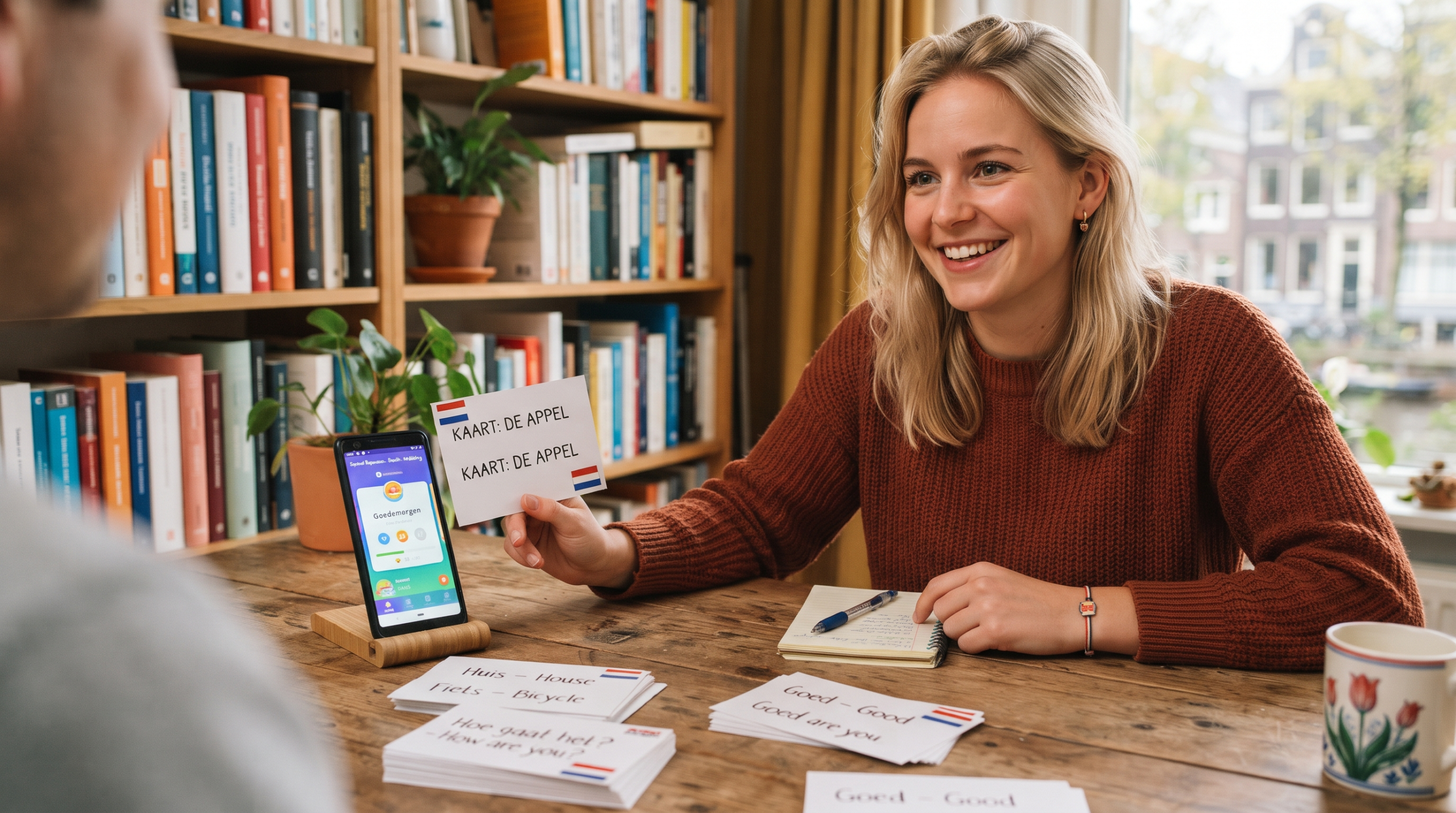
Learning Dutch online works best when you start with the most common words, use them in very short sentences and repeat them patiently until they stick. That is how every child learns a language, and it is the idea behind Ankipedia.
You do not need talent or long study sessions. You need the right words, in the right order, at the right moment. This guide shows you how to do that step by step, with free and paid tools you can use from your phone or laptop.
How language learning works, in four building blocks
Whatever language you learn, progress comes from the same four building blocks. Leave one out and you stall.
- Input you understand. Listen to and read Dutch that is just a little above your level. Short videos, simple dialogues and example sentences are ideal.
- High-frequency words first. A small set of words makes up most of everyday Dutch. Learn those before rare or specialist vocabulary.
- Spaced repetition. Review each word just before you would forget it. This moves words into long-term memory with the least effort.
- Output. Say and write what you learn. Read sentences aloud, copy them, and use them in simple conversations.
Grammar comes along the way. Children do not start with rules; they absorb patterns from thousands of short sentences. Adults can do the same and then look up a rule when a pattern feels unclear.
NT2 levels: where are you, and where are you going?
NT2 stands for Nederlands als tweede taal, Dutch as a second language. Levels follow the European framework (CEFR), from A1 for beginners to C2 for near-native speakers. Knowing your target level helps you choose what to study.
- A1: understand and use simple everyday words and phrases. Your first weeks in the Netherlands.
- A2: handle short, routine conversations about familiar topics, like shopping, the doctor and small talk.
- B1: talk about work, school and daily life, and read simple texts. The level for civic integration (inburgering) and Staatsexamen NT2 programma I.
- B2: follow and join longer discussions and read most texts. Staatsexamen NT2 programma II, higher education and many jobs.
- C1: express yourself fluently and precisely, for university and professional work.
- C2: understand virtually everything; near-native use.
For most newcomers under the Civic Integration Act 2021 the required level is B1. The Staatsexamen NT2 tests B1 (programma I) or B2 (programma II). Check Staatsexamen NT2 and inburgeren with the Staatsexamen for the rules that apply to you.
How to learn Dutch online: step by step
- Set a level goal. Pick the NT2 level you need and a date. "B1 in 12 months" is easier to plan than "learn Dutch".
- Start with the 1,000 most common words. Use a frequency list instead of themed lists like "fruit" or "animals". You will understand far more, far sooner.
- Learn every word in a short sentence. "Hij is moe" teaches you a word, a verb and word order at once. Add audio so you hear how it sounds.
- Review with spaced repetition every day. Ten to fifteen minutes a day beats two hours once a week. Let the flashcards decide what to review.
- Listen a lot. Watch short videos with Dutch subtitles. Replay sentences until you can follow them without reading.
- Speak and write from day one. Read your flashcard sentences aloud. Write three simple sentences about your day.
- Add grammar when you notice a pattern. Wonder why it is mooi huis but mooie stad? That is the moment to look up the rule.
- Track progress, not perfection. Count words learned and days practised. Small daily wins keep you going.
Spaced repetition: remember words for good
Spaced repetition is the single most effective way to build vocabulary. You see a word again just before you would forget it. Each time you remember it, the next review moves further away: after a day, then a few days, then weeks.
The result: less time reviewing words you already know, more time on the words that are hard for you. Ten to fifteen minutes a day is enough to add new words steadily without forgetting the old ones.
Ankipedia online flashcards
Our online Dutch flashcards work in your browser, on any device. Every card shows a Dutch word in a short example sentence, with audio, an image and a translation. The built-in spaced repetition schedules your reviews for you.
Dutch decks for the Anki app
Prefer Anki, the free flashcard app? We offer ready-made Dutch decks with audio and example sentences:
- Dutch verbs: 200 common verbs with conjugations
- Dutch adjectives: 280 flashcards to describe people, things and feelings
- Dutch adverbs: the small words that make your Dutch sound natural
- Free Dutch vocabulary decks to get started
Import a deck once and study on your phone and computer; Anki syncs your progress.
Use a frequency dictionary: the most useful words first
A frequency dictionary lists words by how often they are used. In almost every language, a few thousand words cover the vast majority of everyday speech and text. Words like de, het, is, hebben, gaan and goed appear in nearly every conversation; eekhoorn (squirrel) does not. So learn in order of usefulness:
- The first 500 words: you can follow simple conversations and signs.
- Up to 1,000 words: most short everyday sentences make sense.
- Up to 2,000 to 3,000 words: you can read simple news and handle most daily situations, around B1.
Ankipedia builds its flashcards and word lists on the most used Dutch words, each one in a short, natural example sentence. That way the frequency list and spaced repetition work together: you learn the most useful words, and you keep them.
Learn by scrolling: short Dutch videos
Ankipedia's video scrolling works like the social media feeds you already know, but every video teaches you something. Each short clip shows one common word in one easy sentence, spoken by a native speaker. Scroll, listen, repeat.
Because the sentences are short and built from the most used words, you pick up easy grammar along the way: word order, verb forms, de and het. Just like a child hears the same patterns again and again until they feel natural.
Our large video library comes with interactive tools to keep learning fun:
- Tap a word to see its meaning in your own language.
- Listen and type what you hear, with hints and Dutch spelling tips when you get stuck.
- Read aloud and get feedback on your pronunciation, word by word.
- Save words to your flashcards, so spaced repetition takes it from there.
Watching, listening, typing and speaking the same sentence makes it stick far better than reading a word list.
A simple weekly routine
- Monday to Friday (15 to 20 minutes): flashcard reviews plus 5 to 10 new words; scroll a few videos.
- Saturday: listen and type 10 sentences; read 5 sentences aloud.
- Sunday: rest, or watch Dutch videos just for fun.
Bonus: learn Dutch with films and series
Watching Dutch films and series is a fun way to practise listening. Start with English subtitles, then switch to Dutch subtitles once you know a few hundred words. Need ideas? See our list of 20 Dutch films and series on Netflix to learn Dutch.
Frequently asked questions
How long does it take to learn Dutch?
With 15 to 30 minutes a day, many learners reach A2 within a few months. B1 usually takes longer, depending on your native language and how much Dutch you hear around you.
Can I learn Dutch online for free?
Yes. Ankipedia offers free word lists and free Dutch decks for Anki. Paid decks and the online flashcards add audio, images and ready-made example sentences.
Do I need to learn grammar first?
No. Start with common words in short sentences. Look up a grammar rule when you notice a pattern you want to understand.
Is Ankipedia good for the NT2 exam?
Yes. Our decks and videos focus on everyday Dutch from A1 to B2, the vocabulary you need for inburgering and the Staatsexamen NT2.
Start today
Learning Dutch is not hard when you take it one easy word and one short sentence at a time, with patient repetition. Pick your first deck, watch a few videos, and come back tomorrow.